
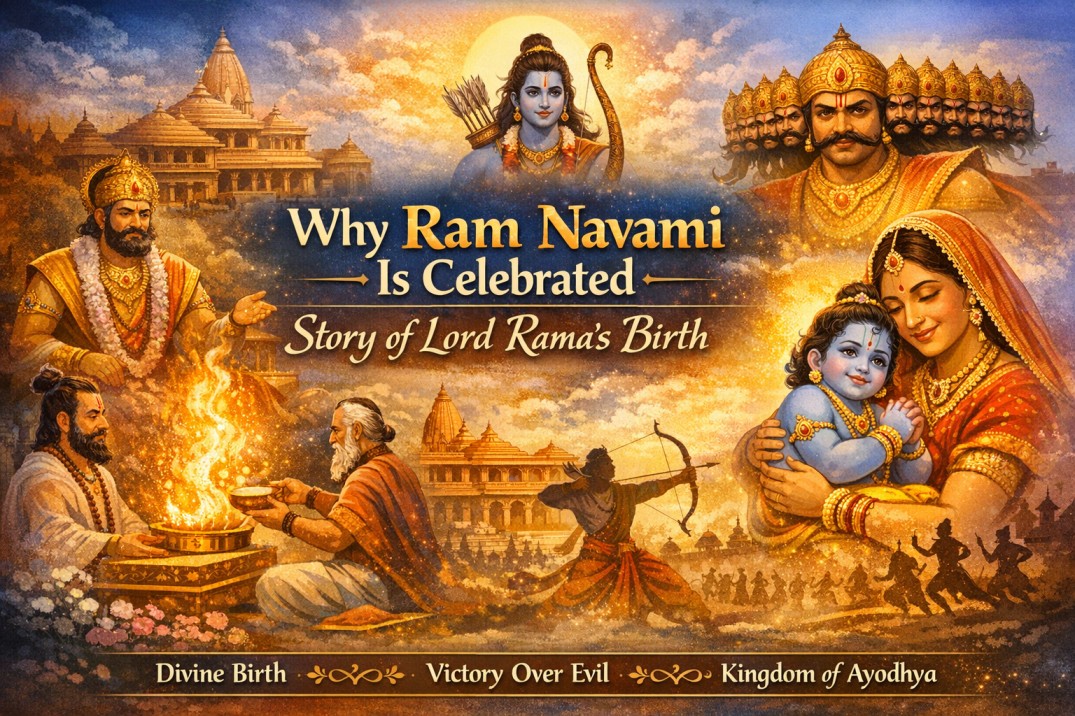
Ram Navami is one of the most sacred festivals in Hinduism, celebrated to mark the birth of Lord Rama—the seventh incarnation of Lord Vishnu.
Observed on the ninth day (Navami) of Chaitra month, this festival falls during Navratri and holds deep spiritual, cultural, and moral significance.
But why is Ram Navami celebrated?
Let’s understand the complete story, meaning, and importance behind this divine occasion.
The Story of Lord Rama’s Birth (Ram Janam Katha)
Long ago, in the kingdom of Ayodhya, there ruled a noble and powerful king named King Dasharatha. Despite having great wealth and power, he was deeply unhappy because he had no children to carry forward his lineage.
The Putra Kameshti Yagna
To seek blessings, King Dasharatha performed a sacred ritual known as the Putra Kameshti Yagna. This yagna was conducted under the guidance of sages to pray for a child.
After the yagna:
- A divine being appeared
- He offered a sacred kheer (holy offering) to the king
- The king distributed it among his three queens:
- Kaushalya
- Kaikeyi
- Sumitra
The Divine Birth
Soon, the queens gave birth to four sons:
- Lord Rama (to Queen Kaushalya)
- Bharat
- Lakshman
- Shatrughna
Lord Rama was born on:
- Navami Tithi (9th day)
- During Madhyahna (midday)
- Under auspicious planetary alignments
This divine moment is celebrated as Ram Navami.
Why Lord Rama Took Birth (Spiritual Reason)
According to Hindu scriptures, Lord Rama was born to:
- Destroy evil forces (especially Ravana)
- Restore dharma (righteousness)
- Show the ideal way of living life
He is known as “Maryada Purushottam”—the perfect man who lived by values, discipline, and truth.
The Purpose: Victory of Good Over Evil
The main reason behind Lord Rama’s incarnation was:
- To defeat the demon king Ravana
- To protect humanity from injustice
His life teaches that:
✔ Truth always wins
✔ Good always triumphs over evil
Why Ram Navami Is Celebrated During Navratri
Navratri is dedicated to Goddess Durga and represents divine feminine energy, while Ram Navami celebrates Lord Rama, representing divine masculine energy.
Together, they symbolize:
- Balance of power and wisdom
- Completion of spiritual energy cycle
That’s why Ram Navami falls on the last day of Navratri.
Spiritual Significance of Ram Navami
Ram Navami is not just about celebrating a birth—it’s about learning and applying values in life.
Key Teachings:
- Follow truth and honesty
- Respect relationships and duties
- Stay calm in difficult situations
- Practice patience and discipline
Lord Rama’s life is a guide for ideal living.
How Ram Navami Is Celebrated
Across India, Ram Navami is celebrated with great devotion:
Common Rituals:
- Fasting and prayers
- Reading of Ramayana
- Bhajans and kirtans
- Temple visits and processions
Special Moment:
- Lord Rama’s birth is celebrated at midday (Madhyahna Muhurat)
Why Ram Navami Still Matters Today
In today’s fast-paced life, Ram Navami reminds us to:
- Stay grounded in values
- Maintain discipline
- Build strong relationships
It’s not just a festival—it’s a life lesson.
FAQs
Why is Ram Navami celebrated?
Ram Navami is celebrated to mark the birth of Lord Rama, who came to restore righteousness and defeat evil.
When is Ram Navami celebrated?
It is celebrated on the 9th day (Navami) of Chaitra month, during Navratri.
What is the significance of Lord Rama’s birth?
His birth symbolizes the victory of good over evil and the importance of living a righteous life.
Why do people fast on Ram Navami?
Fasting is done for spiritual purification and to seek blessings of Lord Rama.
Final Thoughts
Ram Navami is more than a celebration—it’s a reminder of how to live life with dignity, truth, and purpose.
The story of Lord Rama teaches us that:
- Challenges will come
- But with patience and righteousness, you can overcome anything
This Ram Navami, don’t just celebrate—learn, reflect, and apply these values in your life.